Monday, May 23, 2016

338 : White Ibis


White Ibis - Eudocimus albus 

This is a large heavy Ibis with a wingspan of 42 inches. This individual is still molting into its adult plumage which is all snow white with a scarlet bill and black wingtips.


Excitement levels are high  at the moment as I contemplate the approaching Summer and various trips. I find myself without too much to say just now about the birds so I will leave it to the photos. A small pile of gear is starting to pile up for Malaysia. Deet, flash, guide books, leech socks. Awesome.

White Ibis, Eudocimus albus
Grand Lakes Marriot Golf Course, Florida
May 2015

Tuesday, May 17, 2016

337 : Common Linnet


Common Linnet - Carduelis cannabina

More spoils from a final walk on Raspberry mountain.  Sadly a bird in trouble in the UK as it relies on mess. It likes seeds - gorse, thistle, sueda, buckthorn. Sadly it doesn't prosper in woodland or on arable land. I used to see a lot of Linnets on "brownfield" sites when I birded around London. So from a population of 1.2 m in the UK in the 70's they were down to around 600,000 at the last count. One very messy field is a must for land that I will buy when I am older.

I thought this might be a Redpoll (a real excitement for me) but those birds associate more birch wood and conifer. Linnets are more birds of the outdoors rather than the tree canopy.


My family are loons. The boys are always keen to remove clothing in cold weather. They have been in Dubai too long.


It was saying goodbye to Grandma in some ways. Lovely place.


Common Linnet, Carduelis cannabin a  
Raspberry Mountain, Clywd
July 2015

336 : Redstart


Redstart - Phoenicurus phoenicurus

There is a hill near to where my wife's parents lived for their last 10 or so years (in the case of my Mother-in-Law at least who made it to 89 I believe). They lived near to Holywell in Clwyd. More a range of hills or ridge. In the Summer months the boys would stay with their grandmother to escape the Dubai heat. Prior to that we lived quite close in Hale, South Manchester. So probably since they can remember my boys have been chasing up and down "Raspberry Mountain". I am not even sure what its real name is. Last Summer they lost their grandma but that Summer we climbed up the hill again.


Redstart is a great Welsh bird and I have seen them with some regularity in amongst the oak trees near to the mountain. Up close (and I am sorry that I don't have a better picture) they will "shiver" their tails. The smart silver, black, russet and white flash on the crown is a gorgeous combination. I have got the colours pretty much below if nothing else.


I took Jean out for a spin about a few months before died and I think we had Red Kite, Redstart and Raven in one morning - quite a nice suite of Welsh birds.

The Redstart really is a bird of upland woods and scrub. I never saw Redstarts growing up in the South East. Red"Start" means red "Tail" or "Steort" in Old English. Both the male and female birds have striking red under tail feathers. These birds are migrants so only with us for 4-5 months each year.

In one of my books it details the events of the great migrant "fall" of 1965. Birds migrating South from Scandinavia were forced West and then to land by rough weather. Along one 2 mile stretch of coast line near Walberswick in Suffolk one observer logged 15,000 Redstarts. Two redstarts for every step he took. Not just Redstarts but thousands upon thousands of Garden Warblers, Whinchats, Wheatears, Pied Flycatchers. On another 24 mile stretch of coast between Sizewell in Suffolk and Hopton half a million birds were observed. I'd love to see that spectacle once in my life. There is a similar event in a book about bird racing now made into a film with Steve Martin and Jack Black.

Anyway here is just one Redstart bird-marking Raspberry mountain.

Redstart, Phoenicurus phoenicurus
Raspberry Mountain, Clywd
July 2015

335 : Tricoloured Heron


Tricoloured Heron - Egretta tricolour

I keep digging out these US armchair ticks. The Daily Bird is I am ashamed to say 5 years old and it is in fact verging on being a weekly bird. The bird rate is catastrophically low so I have declared this the year of catching up with some short sharp bursts of birding required. More planning is required, odd days, hire cars, cameras sneaked on business trips and so on.

It really only took me about an hour to walk down the edge of Golf fairway on the morning before a work conference kicked off to pick up this lovely Heron. These are an "uncommon" bird in the US and restricted to Florida in the Winter and the rest of the Gulf coast. I did notice the "active dashing" for fish described in the Sibley text.

I am off to the UK on a short business trip next week which is then blurring into picking up my son from Dorney Lake where he is rowing. I was wondering what common birds I have not got a picture of yet on the site from the UK. I thought I'd come up with some firm targets and then just see how many I can pick up Friday Afternoon and Saturday morning.

Just a quick review starts to throw up gaps. How about these 3 starting from the back of any book of British Birds - Corn Bunting, Yellowhammer, Linnet. Now that requires some real farmland birding ! I would be very happy to stroll across a corn field and see any of those in the hedgerows - actually probably easier in the Winter or at a bird feeder.

I am setting myself a "hard" target of getting to 400 birds. before I go to Malaysia. It *should* be possible by trawling photos I have right now and then going for it for 24 hours in the UK. The ducks must be easy ?? Corvids, garden birds, gulls, terns in the UK on breeding rafts ? Ok - I am going to see if I can get to 400 by May 31st and then I can have a centenary retro. I think I promised myself  a top 15 for the new retro. That should be a fun thing to do in a hotel room sometime. Got to get to 400 birds. Seeing 65 species in 24 hours in hard enough in the UK - but taking a picture as well is a tall order. It is all doable though. Just a question of planning surely ?

5 years of the Daily Bird - it is owed a 5th birding present - a little number "4".

Tricoloured Heron, Egretta tricolor
Grand Lakes, Florida
November 2015

334 : Greater Yellowlegs


Greater Yellowlegs - Tringa flavipes

This is a very "vanilla" american wader and happy to pick this up. Told apart from Lesser Yellowlegs by bill length. Its bigger obviously and has more markings across the mantle and neck. The bill is also slightly upturned. The bill should be obviously longer than the head. For me the slight upturn is evidenced above. There is almost a "smile".


Obviously I decided that even with 400 mm of bird cannon I needed to be closer which of course benefits with the in-flight photo.

I am realising now that I didn't really push through my Florida photos with any great drive. I have hundreds of "bad snaps" as a camera setting went wrong at one point. I will piece together what I can.

Next week I have a free day in the UK in between a business trip and going to Dorney Lake to watch my son row in the National Schools Championships. End of May in the UK ? I reckon I should be able to review what I have and specifically target breeding birds. What I need between now and next Friday is an audit of all the UK birds and what I actually have a photo of. Armed with a list I could be ruthless and make a dash for perhaps 30 or so bird species in a day ? Has to be done. I will report on the UK gaps in my post to see where we are. There must be a couple of hundred at least.

Greater Yellowlegs, Tringa flavipes
Grand Lakes, Florida
November 2015

333 : Savannah Sparrow


Savanah Sparrow - Passerculus sanwichensis

I have stumbled across a small cache of photos from a conference in Florida that attended in November with work. I think I managed to "escape" and walk along the edge of a lake (its the Marriot at Grand Lakes near Orlando). I am not sure why I didn't tap them up. I probably obliterated the memory of them in the bar.

This is a bit of armchair footwork but I am settling on Savanah Sparrow after contemplating an awful lot of birds at the sparrow/bunting end of my Sibley. He does have a "distinctive" head pattern, clean white underparts and black spotting on his breast. The range for Lark Bunting and Rustic Bunting is wrong - I almost settled on Lark Sparrow but then Ockhams's Razor came out and an almost double spread on Savanah Sparrow with 20 + illustrations demonstrated that this bird turns up anywhere in the US and have a large number of sub-species.

The head pattern is distinctive and this is an opportunity to talk a few nerdy birdy head pattern terms. I think I got this next shot a bit tighter and I like the background and perch (always a plus in a otherwise boring side shot - he has grabbed a bug juicy caterpillar just to put you off breakfast).


There might be a "median crown stripe" on this bird but we can't see the top of the head. I have another photo that I can check later but a Savanah Sparrow does have a very fine median crown stripe. So the first block of warm brown colour running across the head is the "lateral crown stripe". Underneath that the much lighter colour is the "supercilium" - about where eye shadow should go. Right over the top of the eye there are a few feathers of a different colour yet - where the top eye lashes would join roughly if that makes sense. This is the "eye-arcs" or "broken eyeing". Running directly out of the back of the eye on this bird is another band of darker brown colour which is the "eyeline" or "eyestripe". Underneath that the next band of light buff gown is the "auriculars" - almost where cheeks would be if that makes sense. The next and first almost black lightning strike shape is my favourite of course, the "moustachial stripe". That borders on this bird an almost yellow patch of feathers which is the "malar". The lower black stripe bordering that is the "sub-moustachial stripe" or "lateral throat stripe" and the borders the patch of feathers which is the "throat" itself. Finally the small patch of feathers immediately in front of the eye and behind the bill is the "lores". Sometimes the "eyeline" of a bird can run through this.

When you look at essentially a black, fawn, white and brown like this and notice all the different colours and then start to look at the warm more russet tones in the various wing feathers then its suddenly not an "LBJ" or "Little Brown Job". Finally I promised a look at the top of the head !


A bit more than just a "median crown stripe" going on. There are two more very fine stripes above the "lateral crown stripe" (black then very pale) and then I think a brown patch of feathers and then the pattern started to repeat on the other side of the head.

This is actually lovely picture to observe the wing feathers.  From the tip of the wing "Primaries" then "Secondaries". Running across broadly the middle of the wing down to wear an elbow might be are the "Greater Coverts". On this bird I can count perhaps 7 or 8 individual feathers and they are black and edged in that almost gingery brown turn that is warmest colour on this bird. Above the elbow and close to the wing edge the "Median Coverts" (four black spots here) and then the "Scapulars" almost as a shoulder and finally the "Mantle" for a back. The back of the head is the "Nape" and then we get lost into the head feathering again.

I am getting very excited about my Summer now which is stacking up into some great bird opportunities. UK,  Malaysia (solo quick trip to the rain forest), Paris (perhaps a bit urban !) and then the Seychelles. I have got some camera learning to get done to have any chance of getting detailed well lit pictures in the rainforest like those above. The mysteries of an external flash and "Fresnel Extender are waiting !! Good old Shop and Ship !

Savannah Sparrow, Passerculus sandwichensis
Marriot Hotel, Grand Lakes, Florida
November 2015

Wednesday, May 11, 2016

332 : Bachman's Sparrow


Bachman's Sparrow - Peucaea aestivalis

Here is another "armchair" tick dug up from my trip to Florida for my law firm's  partners conference last year. The photo was taken at 1243 on 23 May 2015 to be precise at the Walt Disney Wilderness Preserve. Mad dogs and Englishman !

This took a good 30 minute trawl through all the sparrow species in Sibley. Quite a nice little photo tick as well as it is an endemic to the South-Eastern United States. It is near threatened due to the loss of the open pine forest habitat it prefers. I guess this is why I found this one on a "preserve" full of pines - go figure !


This is what they need in the same way that we need air, water and food. This sparrow needs open pine with grassland and lots of grass as it is a granivore. The more grass the greater density of Bachman's Sparrows. The americans have measured it precisely.

There are 100,000's of plant species with many as yet described to science. As human's though we depend on just 8 plants in effect for 80 % of our calorific intake. We are a weed that strangles out diversity in favour of monoculture. A few "untidy" edges to the world is all we need otherwise no more Bachman's sparrows.

Bachman's Sparrow, Peucaea aestivalis
Disney Wilderness Preserve, near Orlando, Florida
23 May 2015

Monday, May 9, 2016

331 : Glaucous-winged Gull


Glaucous-winged Gull - Larus glaucescens

There is something good about stumbling across a bunch of photos and realising that you have completely forgotten to "process" them for the Daily Bird. One morning while staying at Pacific Sands resort near Tofino, Vancouver Island and a good 2 year's ago in 2014 I decided to take a walk along the beach and snap as many gulls as I could. The clear idea was that I would wade through them at some point later with a Sibley guide and see what I could "string" together.

Not to disappoint myself I am calling this as a Glaucus-winged Gull. Why ? The range of all the likely candidates do overlap. This was I think July so fairly and squarely in the breeding season. In the Sibley guide all the candidates have head detail drawings and in particular the "orbital ring" of the eye (the bare skin round the eye) and the gape (the bare skin at the very top of the bill) can be diagnostic.


Its very faint but they appear to me to be pink. Coupled with a brown Iris and the lighter slate grey back with a matching colour for the wing tips (i.e. not black with "mirrors" like some species) and I am content with the identification. I can remember the puddle quite well and thinking to myself - oh no Gulls !! Quite a few more to work through and its likely that they are not all the same species.


I should pay more attention to Gulls but sadly they do not excite me in the slightest. Not the same as a tern or a shearwater or a Petrel. ABG - anything but Gulls.

Glaucous-winged Gull
Tofino, Vancouver Island, BC, Canada
July 2014

Sunday, May 8, 2016

330 : Bridled Tern


Bridled Tern - Onychoprion anaethetus

I spent the weekend diving in Oman on a Dhow trip with a different bunch of families. It was mainly about the fish but my eye did wander out to the birds and I managed to remind myself that the Task is still on. I am sure that I have posted about other Dhow trips but they are a firm favourite with the family. A two hour drive over to Dibba assisted by new roads and then a good 3-4 hour cruise up the coast of Oman from about 5.30 pm (the Musandam peninsula) towards the Hormuz straights. You wake up to this !


The geology is spectacular and the sea for once was a great temperature for swimming and snorkelling and as clear as a bell. Turtles, rays, fish - all perfect.


The days are just filled up with diving, snorkelling, eating, banana boat rides, hand lining, more eating, card games, talking and so on. Little or no mobile reception enhances the experience - the out of office just goes on for 48 hours. There is nothing you can do so you just have to go with the flow.


Its relaxed - A bit like this old Omani cargo ship - I'd love to borrow this for a few days and steam up and down the coats rooting out seabird colonies and diving the reefs !


Our own vessel was a touch more up market and equipped (for once) with air conditioned cabins and and a lounge - there were even plugs so one family brought a Nespresso machine. Below wasn't our Dhow but you get the idea. 4 or 5 cabins below and two decks (an upper and lower) also used for sleeping out under the stars and sunbathing etc. big long table for meals.


The bird - 1,000,000 pairs of these in the Indian Ocean and perhaps 50,000 in the Gulf proper. Technically this is not the Arabian/Persian Gulf but the "Gulf of Oman" which is really an offshoot of the Indian Ocean. Its nesting time at the moment and the whole rocky coast will be littered with nests. These birds are ocean going and feed up to 50 km from shore. They roost at night on islands, in trees and also on floating bouys and other debris on the ocean. One report says that they feed and roost on the great piles of weed in the Sargasso sea.

I got this picture of their sea perching habits - here on the float for a lobster pot.


At times you could cruise round the corner to see 1,000 birds filling the sky and all fishing at once. At other times not a Tern for 15 minutes. As I say though ...One good tern deserves another.

I really need to get wedded back to my camera for "context shots" to tell the story of the place and the bird. Can you believe I got so excited with a pod of 10 dolphins I did not even think to grab the thing.

I love reading back the daily Bird - if nothing else it is a good record of trips. More pictures and more effort for the rest of the year ! A promise to myself - I will public publish again when I get to 500 birds. Thats a good round number to aim for this year - I have a lot of travel coming up.

Bridled Tern, Onychoprion anethetus
7 May 2016
Gulf of Oman, off Musandam Peninsula, Oman

329 : Desert Lark


Desert Lark - Ammomanes deserti

More pictures from New Year and we are already into May. I fear that my New Year's resolution has pretty much gone by the wayside. For whatever reason I am bit disheartened by birding in the UAE and have fallen out of love a bit with camera.

The good news is that I have a trip booked to Malaysia in a month - if that can't motivate me to get a good hundred birds under my belt the nothing can. I have the flight booked and accommodation for 4 nights at the Teran Negara national park. With 350 species on the list I should be able to chalk up 100 photos in 3 full days. Never having birded East of India before it should be like clubbing baby seals - we will see.

Back to this bird.


He is a resident and common so you wonder why it has taken me this long to chalk him up ! Perhaps I should be backfilling all the resident birds in the UAE this year ? Have a UAE bio-blitz year with birds.

I guess the other reason I have got distracted is my dalliance with diving which has taken me into  different medium and lined up 100's of species of fish ! A trip to Oman last weekend and 3 dives at various sites had been salivating over taking up underwater photography I could extend the Daily bird into a series of websites with lists :-) We'll see how we go.


For now the Task is back on - this is 329 and by the end of the Summer with trips to Malaysia, Seychelles, UK and France surely I must be able to take the number to 500 - a short sharp injection of birds ! I will see what I can do.

Desert Lark, Ammomanes deserti
New Years Day
Wadi Brossley, UAE

Sunday, January 3, 2016

328 : Black Redstart


Black Redstart - Phoenicuros ochruros

Happy New Year ! The Daily Bird really petered out last year so one resolution is to apply myself a little more to the Task. A New Year camping trip into the UAE side of the Hajar mountains near Wadi Helo provided a good opportunity for a few birds.

The drive out across the desert is an interesting one along the E 102 and crossing the end of Fossil Rock. Up until the rock there are rolling red dunes and then beyond a Gaff plain until the start of the mountains. Turning right we soon got off the beaten track and discovered a brand new pitch - no rubbish, not a bottle top or wrapper. One thing that does disappoint in the UAE is the way that some people treat the natural environment. Anyway a pristine site along a wadi bed and we left it as we found it.


Plenty of rocky hills to climb for the kids (and adults) and lots of shade. Through the day lots of birds to keep me busy. The temperature was beautiful and we stayed for two nights.


A very peaceful and beautiful location - just an hour and a bit out of Dubai.


And beautiful sunsets to see in the New Year.


Back to our Black Redstart this is the male bird and probably representative of the Rufiventris subspecies. In the UK a few pairs of Black Redstarts nest in building sites and quarries - they came back to nesting in the UK on bomb sites after the second world war. The birds here in the UAE are over Wintering and fly North to breed in rocky areas each Summer - typically to Germany and the Ukraine. At our Wadi site there were also females present.


A really good find to end 2015.

Black Redstart, Phoenicurus ochruros
Near Wadi Helo, United Arab Emirates
31 December 2015

Saturday, November 14, 2015

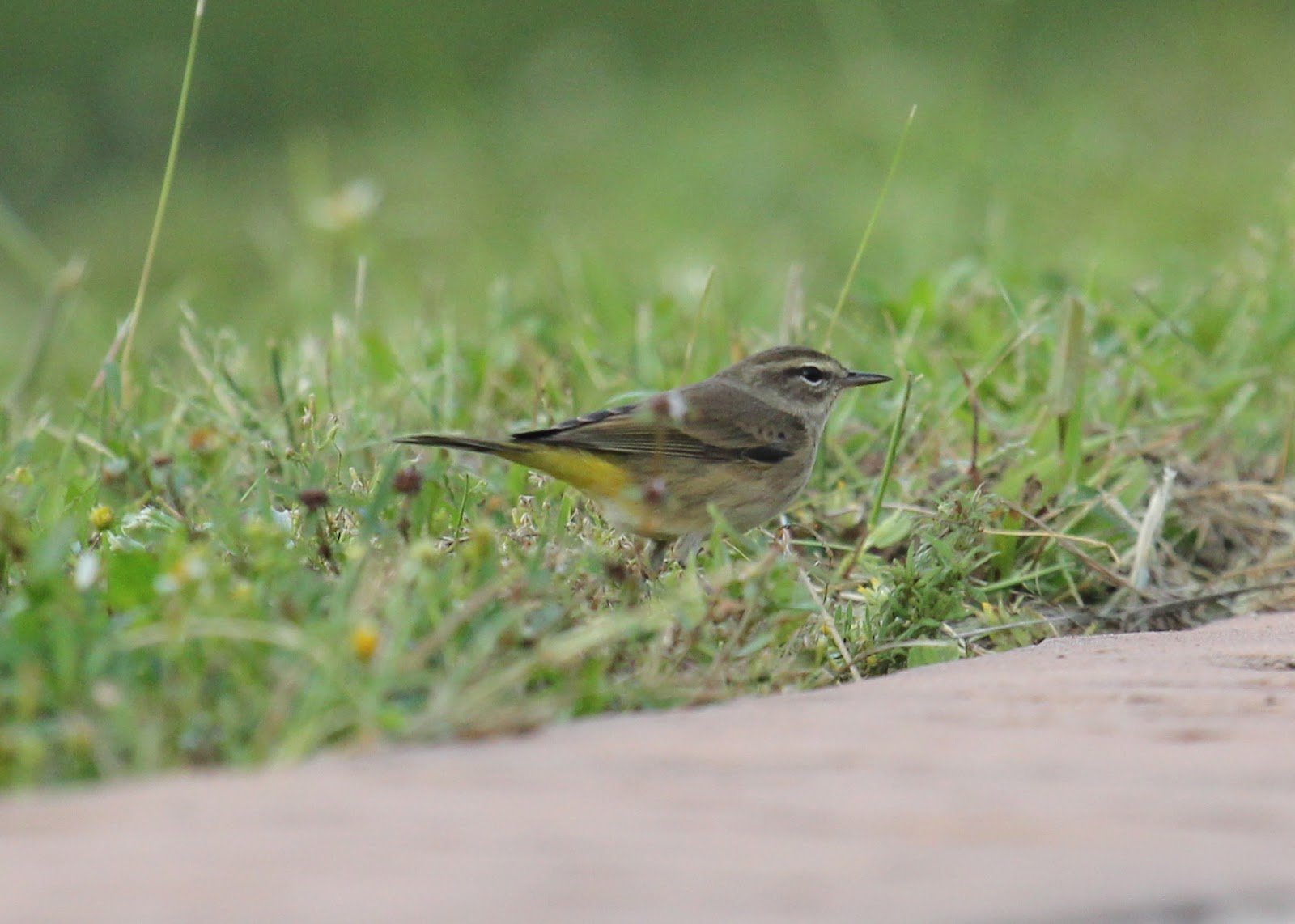
327 : Palm Warbler


Palm Warbler - Dendroica palmerum

So back to the land of Mickey for another business trip but this time in the Winter months so you would expect a few things to drift down from the North seeking out walker clines. Here is one that could not have been there on my last trip. This little fellow and his or her mates down from the North to hide away at the Grande Lakes Marriot in Orlando.

It was a 16 hours each way Yo-Yo with literally 3/4 days in the middle - I even had to speak after dinner. I managed to escape I think for 3 hours before the thing kicked off properly and took a walk down the side of lake next to a golf course. A bit manicured - but here and there quite nice rough bits of meadow with flowers and butterflies. Rough equals food equals birds.


I lay down like a Dhillon to take this (Dhillon is my Obi One and only met him once for 2 days in India - see back !!). "Down be with bird" he might say. So there I lay prostrate - is that a gland or a posture - anyway it was humiliating as all these big lawyer types were jogging past to oxygenate themselves for the conference. Men and Women - running past what I guess is the equivalent of a Dunlin. But we know better. Some stopped and asked.

"Hey buddy what Ya photographing - Oh sorry just a Palm Warbler". "What you looking at ?" - "Oh nothing - Just a butterfly "


I felt justified a day or so later bouncing up on to the stage to Viva Las Vegas after dinner to do the entertainment. I should have switched the slides from films to birds and butterflies.

"What is this US species of blue butterfly - which insect larvae does it predate whilst in a pupae form using a special pheromone to infiltrate the nest. 100 m years of evolution folks ?"


I get it - we all have jobs and we all jog. I have walked on the edge of many many built up areas. I think people are just shy to stop and look - the popularity of wildlife programmes tells us otherwise.

I cannot believe that people can jog past this stuff. "This shit takes my breath away" in the words of the Divine Comedy.

This "Shit" is metres away. Its everywhere. Get prostrate xx

Palm Warbler, Dendroica Palmerum
Marrit, Grand Lakes, Orlando, Florida USA
7 November 2015


Tuesday, August 4, 2015

326 : Black-necked Stilt


Black-necked stilt - Himantopus mexicanus (as per the IOC)

This has to be a contender for one of the most graceful birds on the planet. Not so far off an Avocet  and of course in the same family as the Western Palearctic's Black-winged stilt. I have run into a controversy with myself today though - is this a different species or simply a subspecies of the European bird. It all depends on which global bird list you follow.

The European birds have no black markings on the neck at all - to my eye they look completely different. My Handbook of the Birds of the World in a very imperialistic tone merely categorises this as a sub-species of Black-winged Stilt. Sibley on the other hand the premier hand-held text book for the US states that this is a separate species. How far apart do populations have to drift before they classify as a separate species altogether. I think I have discussed this before with gulls - how around the world say a Lesser Black-backed gull will morph into 3 or 4 species with sub-sets as you circle the planet. We see the same thing with Herring Gull morphing into Yellow-legged Gull and then Caspian Gull. What's the scientific answer. I could just rely on Sibley or find a list that states that Mexicanus is a separate species. The debate is between the "splitters" and the "lumpers". One thing is for sure is that I have discovered that I haven't posted a Black-winged Stilt at all yet which could make for a very easy win with a 20 minute drive to the Creek in Dubai ! (August ticks being hot to come by but I know an air-conditioned hide).

It does appear that the AOU (American Ornithologist's Union) treat this bird as a separate species and really then I should relabel this page Black-winged Stilt and then describe this as a sub-species based on the Handbook. The classic scientific definition to actually answer my own question is that a species is the largest class of hybrids of a collection of animals capable of sexual reproduction resulting in viable offspring. That doesn't seem to be the end of it though with birds as every Tom Dick or Harriet (I hope) wants a species names after him or her so tries to split them out with voice, DNA, behaviour, and looks all being thrown into the mix. Someone declared a new owl species in Oman down the road based on a different song - now apparently they are doing it with some owls on every tiny Pacific island. Logically if you follow every variation you must end up with tens of thousands of different species. Are the Galapagos finches with different bills for each island species or sub-species.

When Darwin travelled on the Beagle he went not as a scientist but as the Gentleman companion to the captain. A bit like Maturin to Aubrey from the O'Brien novels but without leg-sawing duties. Darwin got interested in the question of why there were so many species when a man told him that he could tell which island a giant tortoise came from purely based on the shape of its shell. Tortoises from dryer islands had a raised shell at the front entrance which allowed them to crane for the higher branches of the vegetation something like a giraffe in the bush. On more irrigated islands the tortoises lacked this adaptation as they only needed to graze on the ground to survive. In times of drought on the drier islands only the tortoises with the adapted shell's survived as they had more opportunities to feed and so in time all non-adpated tortoises died out and all the offspring had the raised shell. I wonder why the american stilts have black-necks ? Accident or opportunity ? Fashion or utility ?

I am none the wiser just now for my research but it appears that for this Stilt grouping you can treat them as 1 species with 7 sub-species of 7 seperate species or even 2 species each with 3 or 4 sub-species - there are other permutations. I think we leave this debate for now - it doesn't impact on me tactically until I have to post up another stilt and come out as a splitter or a lumper. I did say in my "rules" which list I was following and jumping ship is probably not then appropriate. A shame but there you go.

How about just admiring the bird ?


By reference to the size of its body those have to be the longest legs that you can see on a bird. Disproportionate even beyond cranes and herons. When it flies the long trailing pink legs are ridiculous - somehow they don't snap when it lands.

I am torn back to the controversy - "most sources recognise 6 species in 2 genera" says Wikipedia. I think I need to go back to my rules and settle this before I post - Himantopus himantopus mexicanus (a tri-named sub-species) or Himantopus mexicanus (a species proper). We go by the rules of this site or we have to change the rules. Well the Task page of this site says (back on the day "1" when I set out on this journey or whenever I first stumbled into this issue) that I am going by the IOC list of birds - I think that's the International Ornithologists Committee or Converntion ...Do they have this much difficulty in Bake-Off - yes they do....do they vote ? They must vote after a scientific debate - can anyone go and wave a picture of  bird with a new coloured eye ? so I am off to the IOC list to see what the birdy gnomes who have got themselves elected to that body and get a vote er... have voted. What are the politics of it - is it a self perpetuating oligarchy or is it elected ? Can any numpty get on it or do you have to have a degree in birdology ? - is it riven by great schisms between lumpers and splitters. It must be the fault line of the battle but in general a splitting body if it has made it to  6 species for stilts whereas the Handbook of the Birds of the World is stuck at 1 - a bit conservative and European me thinks.

So for the record its the IOC list (sounds nice and official like IMF or IWB or WWF) and I won't get thrown or debate this publicly anymore. If my Handbook lists something as a sub-species I will check the IOC list and that will be that. It looks very different to me and I had to fly across an ocean to get it   ! Whichever pair of stilts made that crossing and had descendants with lovely bi-coloured heads deserve separate species status on Neil's Daily Bird. Hallas.

It is a separate species according to the IOC. Marvellous. Looks like a trip to the creek then and we can  do a compare view ! Or is it marvellous - that means I have to go chasing 5 other species of stilt rather than relying on this one picture from Christmas, Florida (thats the town not the season).

Lets have a butterfly to close the issues. Some sort of swallowtail - haven't a clue - next to the car park when I realised I hadn't brought any lunch and was starving and was in Hicksville USA on a Sunday with nothing but Wolf FM the sound of country for company...howling out to you !


Black-necked stilt, Himantopus mexicanus
Orlando Wetlands Park, Florida, USA
July 2015

Friday, July 24, 2015

325 : Anhinga


Anhinga - Anhinga anhinga

Perhaps the strangest bird encountered for a long time. A reptilian monster that for much of the time struggles to take on the form of a bird. Part of the global family of "Darters" of which there are 4. They do look related to "Cormorants" and they certainly hunt and eat fish below the surface but the comparison ends there. Take a look at an Anhinga grabbing a quick breath while hunting underwater.


The  whole body of the bird is submerged and just the snake-like head is visible as it catches a breath. Sinewy and rope like the bird can twist around underwater to chase and spear its fishy prey. The other views of Anhinga you are likely to get are of them drying out their feathers onshore for an age which must be an important process. Typically a duck or other water bird has strong waterproofing provided by oils and preening. My understanding is that Anhingas who have to swim for a living dispense with this to allow themselves to sink and in order to keep the feathers in working order for flight long hours are spent drying out after each dive.


So not the most attractive of birds but in many respects you have to admire the year's of evolution that turns a perfectly good bird into a snake-necked submarine hunter. Whilst I caught up with this species in Florida they are a bird typically of South America and the waterways and rivers of the tropics. Straight from Jurassic Park.

Anhinga,  Anhinga anhinga
Florida, Orlando Wetland Park
May 2015

Thursday, July 23, 2015

324 : Northern Cardinal


Northern Cardinal - Cardinalis cardinalis

I have heard americans refer to these as "redbirds" and you can see why. They are resident in the Eastern and mid-West but do not seem to have a range that extends to across the Rockies to the West. They are ask resident in Mexico.


The red colour seems to be quite hard for the the camera to cope with in terms of picking out feathers.  They remind me of  Hawfinch in the UK in terms of bill structure, size of head etc. but of course I never have and never will see a Hawfinch because they don't exist !!

Its a while since I was in Florida but I guess something else to report from the trip was my bemused discovery of country music. The only genre where people just drink, have failed relationships and drive around in trucks all day. I am not sure it is my music !

Northern Cardinal, Cardinalis cardinalis
Orlando Wetland Park, Florida
May 2015


Tuesday, July 14, 2015

323 : Red-winged Blackbird


Red-winged Blackbird - Agelaius phoenicus

It has taken me several weeks to put fingertips to laptop again to start to complete my Florida bird set. So long in fact that I find myself in the Lake District on my next trip - the annual family holiday. But back to Florida first and a staple American bird.

The red epaulettes on this bird take it beyond the ordinary even if it is common. These birds were abundant around the hotel and at the Orlando Wetland Park. So abundant in fact that it is considered an agricultural pest and is shot, poisoned and trapped. Despite this there remain 200 m individual birds across the States, Canada and down into Mexico and Central America.

The photo above was taken on the scrubland around the hotel.

Red-winged Blackbird, Agelaius phoenicus
Scrub near Hilton, Orlando, Florida
May 2015


Wednesday, May 27, 2015
322 : Eastern Meadlowlark


Eastern Meadowlark - Sturnella magna

A nice dashing lark of open grasslands. I got very excited on the drive into the Disney Wildlife Preservation. My first views of a low flying bird with down curved fast beating wings  had me convinced that I was looking at some form of grouse, quail or partridge. The bird then sat up on a bush singing and I pounded out 30 or 40 shots to try and get a good one. Reminded me a bit of the Longspur from the Serengetti. Similar yellow colouring and so on and size and habitat. This reserve certainly had the feel of some type of savannah at its entrance.


Typically then there was a pair of them sat on the lawn at the education centre (shot above) that I could just walk up to and snap. It is always the way !

Eastern Meadowlark, Sturnella magna
Disney Wilderness Preservation, Kissamee, Florida, USA
26 May 2015